
-
About Homer
-
- Americans with Disabilities Act Compliance Program City CampgroundsCommunity Recreation COVID-19 Hickerson Memorial Cemetery
- Library Parks & Trails Public Safety Fire Police Emergency Information
- Events & Activities City Calendar Library Calendar Recreation Calendar Doing Business in Homer Sister City Program Coast Guard City
-
- Departments
-
Government
-
- Office of the Mayor City Council City Clerk's Office Committees & Task Forces
- Commissions & Boards ADA Advisory Board Economic Development Advisory Commission Library Advisory Board Parks, Art, Recreation & Culture Advisory Commission Planning Commission Port & Harbor Advisory Commission
- Homer City Code Public Meetings Agendas & Minutes Invitations to Bid & RFPs
-
- How Do I?

Homer Public Library
Welcome! The library is open M/W/F/Sat 10:00-6:00pm and Tu/Th 10:00-8:00pm.
Curbside pickup is available. Click here for updated services.

Summer is a great time for kids to enjoy different indoor and outdoor activities. Whether young children or teens, Homer’s Safe and Healthy Kids Fair offers plenty of great activities to help kids be healthy and safe when they enjoy summer fun.
The theme this year is "May the 4th be with you!" Star Wars costumes are encouraged!
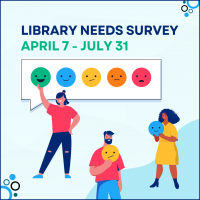
Open April 7th - July 31st, 2024
We want your feedback! The Library Advisory Board is conducting a review of library services and activities. Your comments, both positive and negative, will inform library plans and goals over the coming years.
Thank you for your time and consideration!

We’ve created a community-wide initiative to read fifteen books throughout the year. Anyone can participate, although the books were chosen with adults or mature teens in mind.
Resolve to read more in 2024!Each book you've read (and reported) enters you into a monthly drawing for a prize. Any person who reads and enters fifteen or more books by the end of the year will be eligible to win the grand prize!
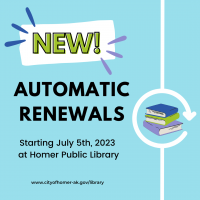
NEW! Automatic renewals at the Homer Public Library
Starting July 5th, 2023
Eligible items checked out from the library will now automatically renew on the original due date! Books, DVDs, magazines, and most other physical items will renew automatically twice...
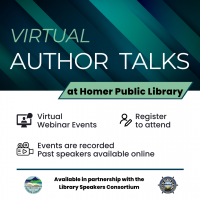
Enjoy a range of talks from bestselling authors & thought leaders!
Brought to you in partnership with the Library Speakers Consortium.
Want to learn more? Explore all upcoming talks!
Events are recorded and available online.
Click here to view past event recordings.
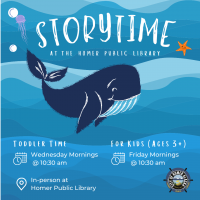
Let's read, dance, sing and get silly!
Join us Wednesday mornings at 10:30am for Toddler Time! For kids under the age of 3.
For ages 3+, join us on Friday mornings at 10:30am for Kids Storytime!
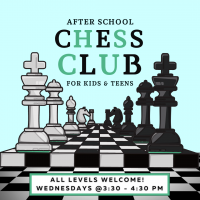
Wednesday afternoons
3:30-4:30pm
Ages 5 and up
Meet your friends at the library to play chess! Improve your strategy, learn from mentors, and have fun. All skill levels welcome!
*MONDAY* May 6th, 4:45-5:45
Want to meet other teens and tweens who love reading and the library? Got ideas about fun things to do at the library? Need service hours for school? Join the library's teen advisory board!

Call 988
The National Suicide Prevention Lifeline is switching to a three-digit number (9-8-8) on July 16, 2022. Alaska is preparing to transition to 988 but until it is active you can still call the Lifeline at 800-273-8255 or the Alaska Careline at 877-266-HELP.

Download ebooks and audiobooks - from anywhere!
With media available 24/7, your library is always open! Download ebooks, Kindle books and digital audiobooks from the Alaska Digital Library, with a valid library card, your account's PIN (password), and an internet-enabled device.

Online lessons that are quick & easy!
Choose from 71 languages and 19 ESL courses, available wherever you're online!
Each lesson combines real life situations and audio from native speakers with simple, clear instructions.
Courses are presented with an appreciation for cultural nuance and real-world application, integrating components of vocabulary, pronunciation, grammar, and culture.

Need help finding something to read, watch, or listen to? Complete the form below, and we will create a list of recommendations for you. You can expect a response within a few days. Call 235-3180 if you would prefer to speak with a staff member.
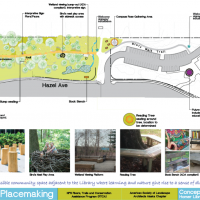
The Friends of Homer Library (FHL) is partnering with the National Park Service to create a new community space in the 2.24 acre land parcel between the library and Poopdeck Trail. We hope to extend the library's mission beyond the limits of the physical building. We hope to maintain the character of the landscape while making use of its location within the city center to turn it into a cultural, educational, and recreational asset for the community.
Learn more about the project!


